If you spent August catching up on July’s rule changes, Canberra moved the finish line while you were looking down. The Bill became an Act, several provisions started a week later, and the rest now have dates instead of an “if” attached. Here is what changed, what it means for a working provider, and what needs doing before October arrives.
Canberra stopped drafting
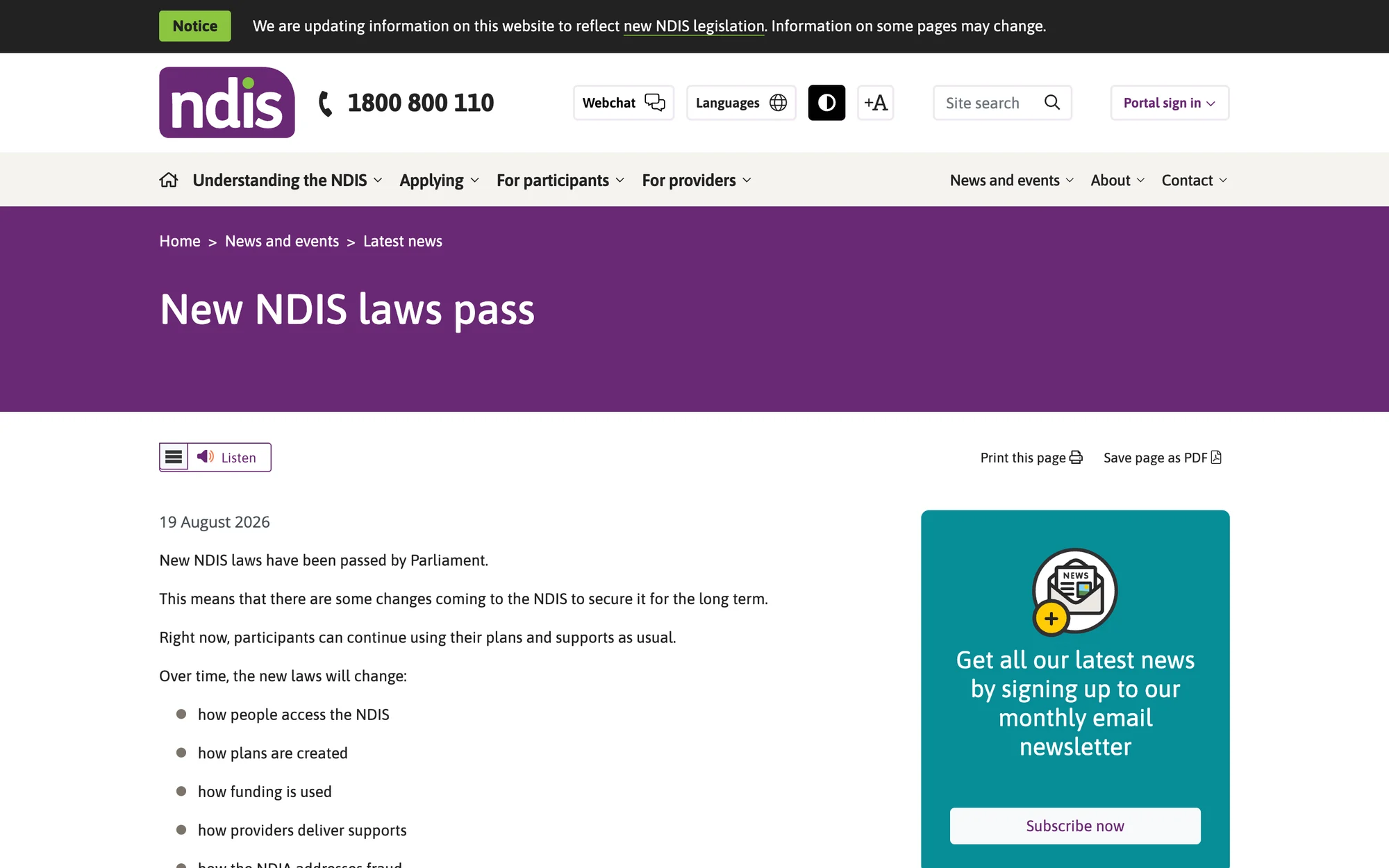
The Bill discussed here last month passed both Houses on 19 August and received Royal Assent on 20 August. It is now the National Disability Insurance Scheme Amendment (Securing the NDIS for Future Generations) Act 2026, Act No. 66 of 2026. The first tranche commenced seven days later.
The provider version of the commencement table looks like this:
- 27 August 2026: tighter plan reassessment rules, new fraud and information-gathering powers, the record-retention framework, and the Minister’s power to make NDIS pricing determinations commenced. There was no immediate change to the current prices.
- 1 October 2026: support determinations and plan-suspension provisions commence.
- 1 December 2026: the maximum time for making a claim drops from two years to 90 days.
- 1 February 2027: plan renewals and the new reasonable and necessary criteria commence.
- 1 July 2027: expanded mandatory registration starts for personal care, daily living and supports delivered in closed settings.
The Act and commencement table (opens in a new tab) are on the Federal Register. The NDIS implementation page (opens in a new tab) is easier reading and will be the better bookmark as guidance is added. July was about preparing for a Bill. August turned it into a calendar.
A provider can support a reassessment. It cannot request one
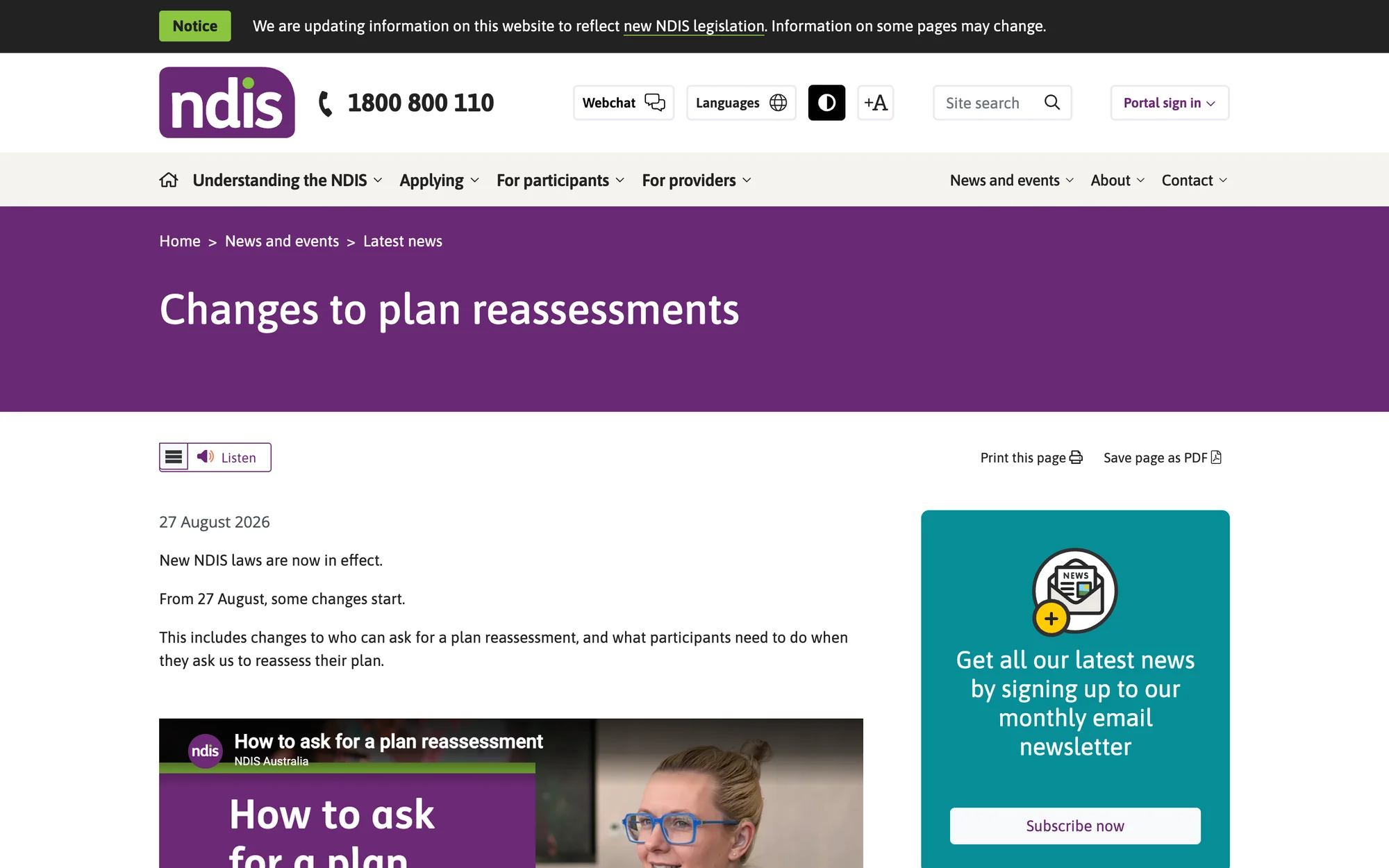
From 27 August, only the participant, their plan nominee, or their child representative can request an unscheduled plan reassessment. A provider or support coordinator acting only in that role can help assemble the evidence, but cannot lodge the request in their own right.
The threshold tightened too. The request must describe a significant and ongoing change in the participant’s functional capacity or support needs, or an unanticipated, significant and ongoing change in their living, education, work or informal-support arrangements. It must use the approved form and include the information and documents the NDIA asks for, which may include evidence from a GP or another health professional. Once the required material is in, the NDIA has 90 days to decide whether to reassess, refuse or vary the plan.
Plan variations remain available for urgent, minor or short-term changes. That distinction matters on the ground. If a participant’s situation changes, first work out whether it needs a variation or a full reassessment, then help the participant or nominee build the record from current notes, incident reports, roster changes and clinical evidence. The NDIS reassessment update (opens in a new tab) sets out the new path.
Seven years for the file, 90 days for the claim
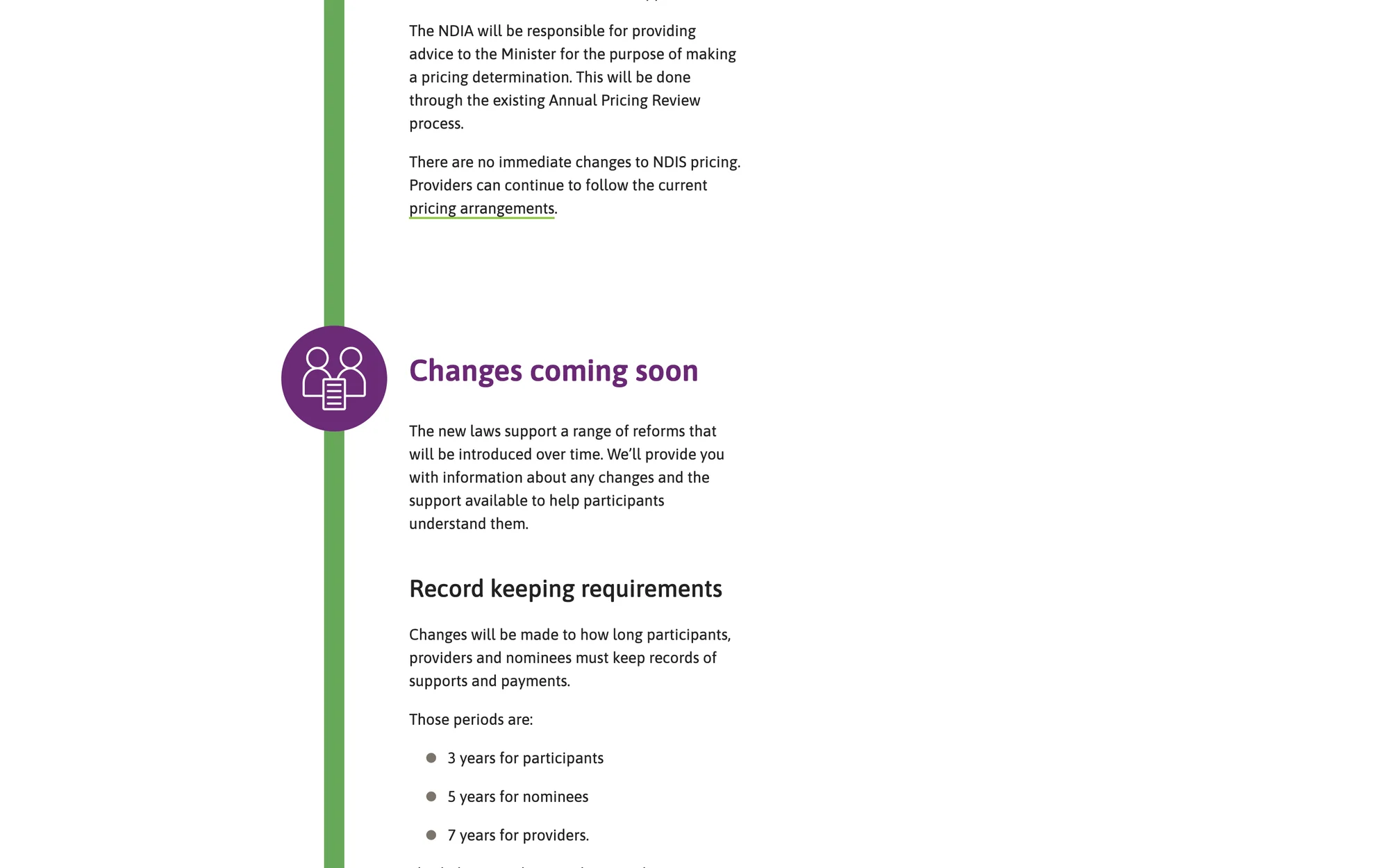
The Act now creates a seven-year retention period for prescribed provider records relating to a claim and the support behind it. It applies to claims made from 27 August. The exact kinds of records will be set by NDIS rules, and the Agency says more guidance is coming, so this is a filing-system warning rather than a finished checklist.
The consequences are not decorative. Failing to keep a prescribed record can attract a civil penalty of 120 penalty units. If the record is missing and the provider cannot otherwise demonstrate that it was entitled to the payment, the payment can become a debt to the Agency. Records must be in English, or readily accessible and convertible into English. Participants have a three-year period and nominees have five years.
Then comes the shorter clock. From 1 December 2026, claims must be submitted within 90 days of the support being delivered, replacing the current two-year window. The law is settled even though operational guidance may still add detail. Run an aged-unclaimed-work report now, clear anything already outside 90 days, and shorten the path from approved shift to lodged claim. December is the deadline, not the sensible month to begin the cleanup. The department's change guide (opens in a new tab) has the provider timetable.
Two budgets are about to get smaller
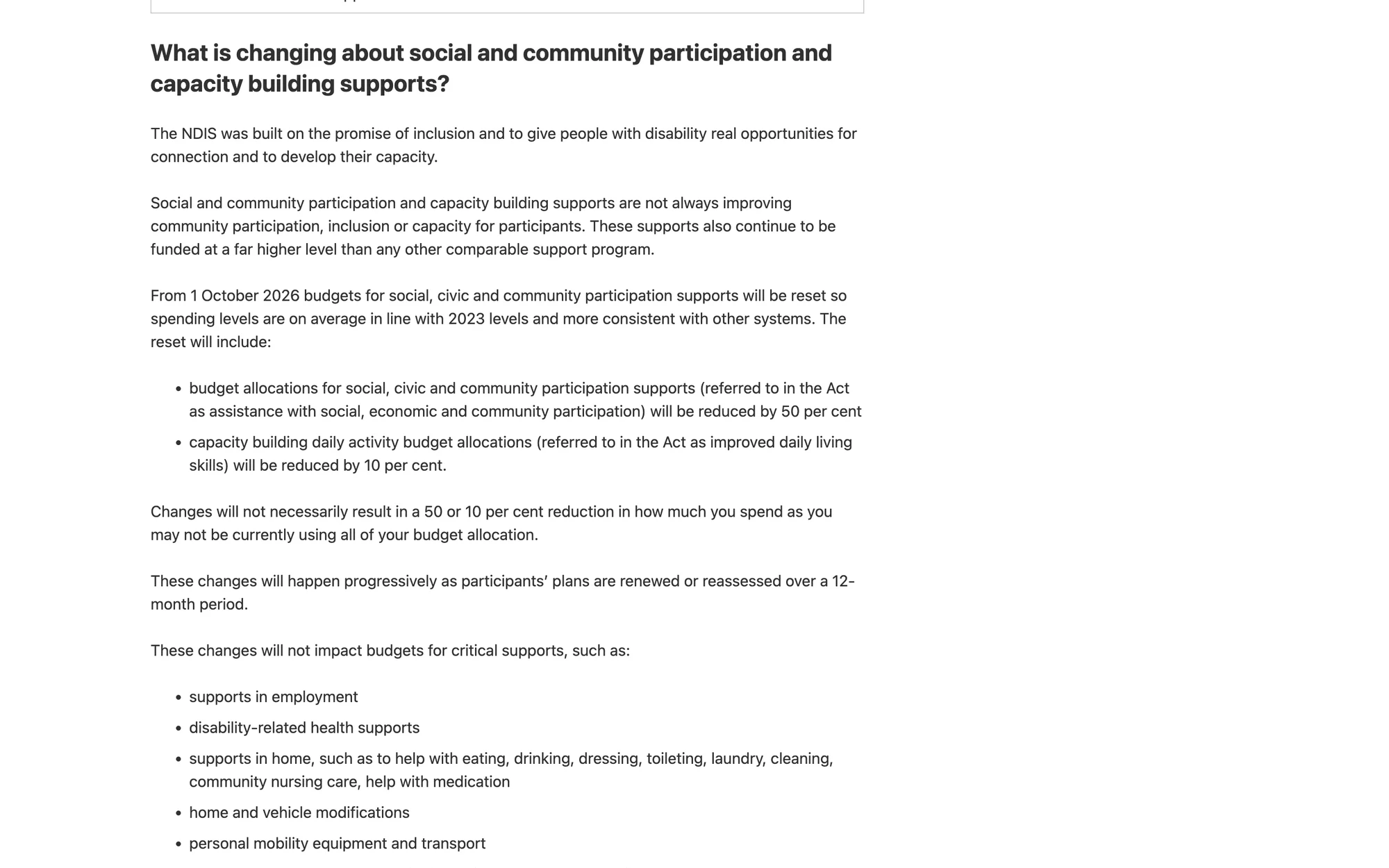
From 1 October, when a participant receives a new or reassessed plan, the government says two funding components will be reset:
- social, civic and community participation funding will reduce by 50 per cent
- capacity building daily activities, also described as improved daily living skills, will reduce by 10 per cent.
This does not cut every plan overnight, and it is not backdated. It begins with new and reassessed plans from 1 October, then reaches renewed plans from 1 February 2027. The change does not apply to eating and drinking supports, education supports, employment supports or disability-related health supports. A separate variation path is planned for participants with high support needs who require continuous 24-hour care.
Providers working heavily in either category should identify the participants most exposed, model what the new budget could sustain, and be ready to revisit rosters and service agreements when an updated plan actually arrives. Do not pre-empt the NDIA by cutting a current service against a current plan. The practical job is to know which conversations are coming and have them before the first reduced budget is already half spent. The department's detailed explanation (opens in a new tab) is the clearest source on the percentages and exceptions.
The annual numbers landed
The June-quarter report arrived on 26 August, which means the first full-year view of 2025-26 is finally public. It is 91 pages long. The provider section earns its place in your reading queue:
- There were 782,013 active participants at 30 June, a net increase of 7,557 during the quarter.
- Providers delivered $51.5 billion in supports over the year, up 25 per cent across two years.
- Of the $13.3 billion paid in the June quarter, 64 per cent was plan-managed, 26 per cent NDIA-managed and 9 per cent self-managed.
- The quarter counted 280,258 active providers. Among providers paid through plan managers, registered providers were only 8 per cent by number but received 59 per cent of the money. Unregistered providers were 92 per cent by number and received 41 per cent.
- Just 1,501 plan managers supported 539,528 participants. The participant count grew from 418,314 over two years while the number of plan managers barely moved.
- SIL reached 36,874 participants and $16.6 billion in annual payments, with payments growing at an average 9 per cent a year over two years.
The useful conclusion is not merely that the Scheme is large. It is that most participants touch plan management, a small plan-manager cohort carries a growing workload, and registered providers collect a disproportionate share of plan-managed payments. Changes to plan management, registration and evidence requirements will travel through this market quickly. The quarterly reports page (opens in a new tab) has the report, appendices and dashboards.
A one-time code may now stand between you and a phone call
From 10 August the NDIA began using extra identity checks when people contact it, or when it calls to update personal information. The check may be a one-time code sent to the mobile number or email address on file, or additional identity questions. Providers should keep their own details current in myplace and encourage participants and nominees to do the same before an urgent plan issue makes the outdated number important.
One operational note worth making explicit: staff should never ask a participant to forward an NDIA one-time code. Help them prepare for the call, not impersonate them on it. The identity-check announcement (opens in a new tab) explains the change.
Circle these dates
- 28 September 2026, 5 pm AEST: the survey on the continence provider list closes. The survey notice (opens in a new tab) has the link.
- 1 October 2026: existing unregistered SIL providers must have applied for registration to keep operating through the transition.
- 1 October 2026: the support-budget reset starts with new and reassessed plans, and the staged rollout of Thriving Kids supports begins.
- 10 October 2026: consultation on updated new framework planning rules closes.
- 31 October 2026: consultations on commissioned SIL and social and community participation market reforms close. The reform timeline (opens in a new tab) tracks both.
- 1 December 2026: the 90-day claiming window starts.
- 1 February 2027: plan renewals begin, unspent funds stop rolling into the renewed plan, and the revised reasonable and necessary criteria commence.
Where OneForce Care fits
A short word on our end, because August turned administrative delay into balance-sheet risk. OneForce Care keeps the participant plan, service agreement, delivered shift, worker time, travel, notes, incident evidence, invoice and payment result on connected records. Billing already warns when an NDIA claim row is more than 90 days old, and generated batches retain the path back to the work that created them.
That does not replace a provider’s retention policy or the detailed NDIS rules still to come. It does remove the part where the evidence sits across a roster spreadsheet, a worker’s phone and a folder named FINAL-final.
If August involved learning that “two years” becomes “90 days” in December, that is worth a conversation.